
Good food content makes people hungry. It does not tell them your price, whether you are open, or if you deliver to their area. Most restaurant social media creates the craving and then loses the customer in the next thirty seconds. We build the whole path.
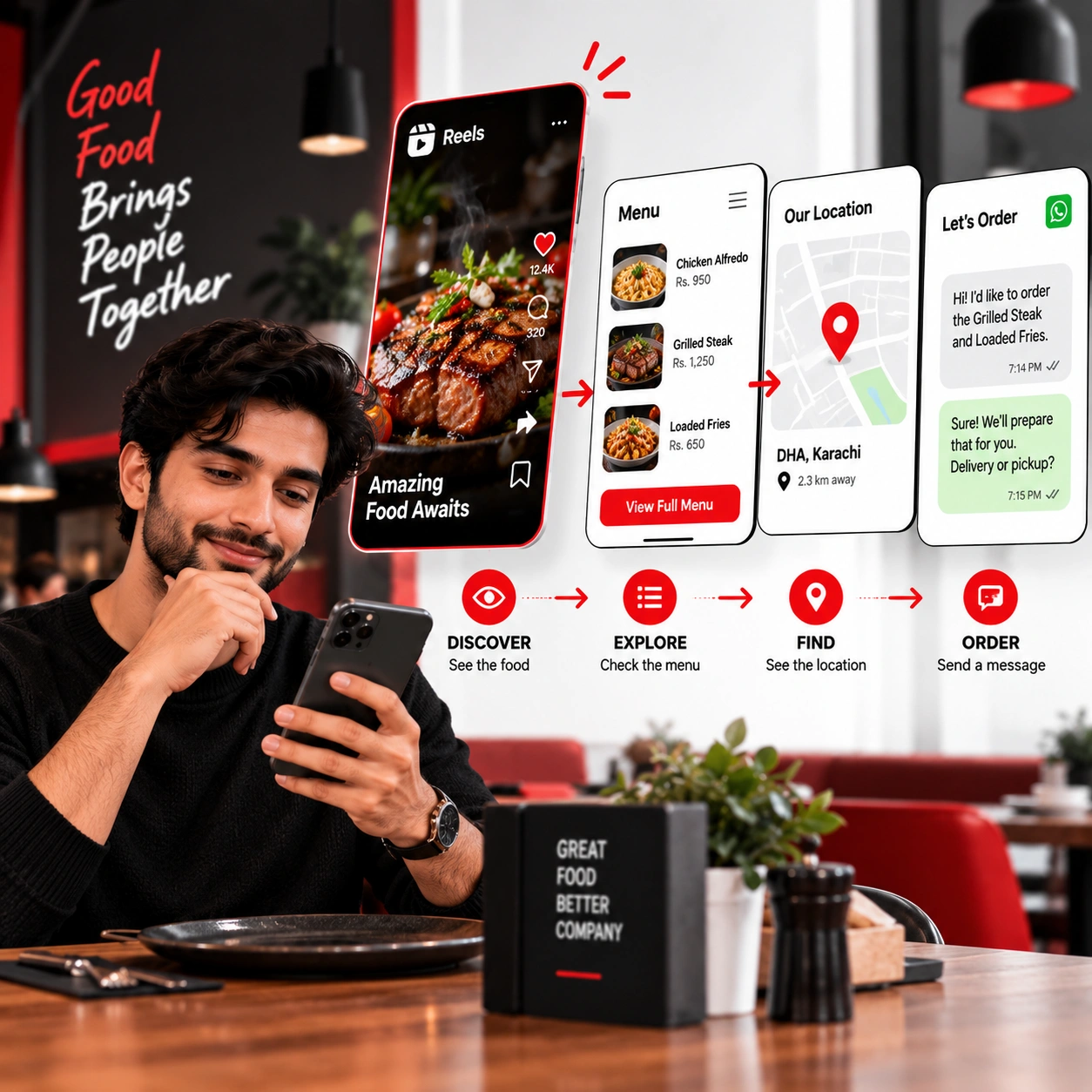
How people choose where to eat
Deciding where to eat takes most people less than a minute and runs through four stages. Nearly every agency works on the first. Almost nobody works on the second, which is where restaurants quietly lose the customers their content just won.
STAGE ONE
Nobody scrolls looking for a restaurant. They scroll, something makes them hungry, and the restaurant becomes a candidate. This stage is about being the thing that interrupts, which is why short-form video carries most of it.
Most restaurants have two or three items people actually come for. Those deserve repeated, better content rather than equal airtime with the whole menu. A reel of the thing you are known for outperforms a carousel of nine dishes almost every time.
People choose restaurants for the food and cafés for the space. Lighting, seating, how busy it looks at 8pm, whether it suits a family or a laptop. This content is consistently underused and it answers a question the menu cannot.
Food being made travels further than food sitting finished. The grill, the dough, the pour, the chef who has made the same dish for eleven years. It is also the cheapest content to produce, because it happens anyway.
Guests film your food already. Asking properly, reposting with credit and making the tagging path obvious turns that into a supply of content you did not shoot and social proof you did not write.
A dinner post published at 3pm competes with work. The same post at 6:30pm reaches people who are already thinking about the evening. Timing is one of the few free improvements available on an organic account.
Boosting whatever performed organically is not a campaign. A campaign promotes one thing to one audience for one reason: a new dish, a weekend offer, a branch opening, a delivery push. Everything else is spending to reach people who already follow you.
STAGE TWO
The craving is made. Now a different question starts, and it is entirely practical. Is this for me, at this price, near me, right now? The answer has to be findable in seconds, and on most restaurant accounts it simply is not there.
Every campaign sends people somewhere, and the destination changes what the campaign is worth. Your profile is fine for discovery but answers nothing. A menu page answers the practical questions but needs to load fast on mobile data. A delivery platform listing converts well and charges commission on a customer your own content produced. A WhatsApp thread keeps the margin and the relationship but only works if someone answers it.
There is no universally right answer, and it changes per campaign. A dinner campaign for a dine-in restaurant and a late-night campaign for the same kitchen should probably land in different places. What matters is that the choice is deliberate rather than whatever link happened to be in the bio. The broader question of delivery platforms against direct discovery is covered on our restaurant SEO page, which deals with the channel decision rather than the campaign one.
STAGE THREE
The decision is made and it now has to survive contact with your operations. In Pakistan this almost always means a message rather than a form, which makes your inbox part of the marketing whether anyone treats it that way or not.
Restaurant inboxes are usually answered by whoever is free, which means fast at 4pm and never at 9pm. The enquiries that arrive during service are the ones most likely to convert and the least likely to be seen.
Price, timings, delivery area, table for how many, is the offer still running. Six or seven questions cover almost everything, which means they can be answered consistently rather than improvised by whoever picks up the phone.
Every extra step between wanting the food and asking for it loses people. A message button that opens a chat with the restaurant name already in it converts better than a phone number someone has to copy.
We agree the reply tone and a set of standard answers with you in advance, monitor comments and direct messages on the platforms in your plan, and pass genuine enquiries to your team with the conversation attached. Questions about availability, a specific booking or a complaint are usually better answered by you, and we will say so rather than guess on your behalf. Where enquiry volume gets beyond what a person can watch during service, automated first responses are worth a separate conversation.
STAGE FOUR
A first visit is expensive to buy and a fourth visit is nearly free. For cafés especially, the business is built almost entirely on people who come back, which changes what the account should be doing once someone already follows you.
Existing followers do not need to be told you exist. They need something new: a dish, a seasonal item, a change to the space, a reason this week differs from last.
Ramadan and Eid reshape the entire trading pattern, and planning for them in the preceding weeks works better than reacting. Weather, school terms and long weekends move demand too.
A discount every second week teaches customers to stop paying full price. Offers work better tied to a moment, a new item or a quiet daypart you actually want to fill.
The people already coming back are your most credible material. Reposting their content and replying to them publicly does more for a local account than reach campaigns aimed at strangers.
The part nobody explains
Every agency page implies a camera crew. The honest version matters more, because this is the thing that breaks restaurant social media contracts in month three, when the material from the first shoot runs out and the calendar still needs filling.
How DIGICS works: depending on the project, we work from footage you supply, from stock and motion graphics, or from material shot specifically for the campaign. Original video production is agreed and quoted separately rather than assumed inside a monthly fee. Being based in Karachi means we can attend a shoot in person where a project needs one.
That arrangement is worth understanding before you sign anything, with us or anyone else. A monthly fee that includes a professional shoot every month is either expensive or not really happening.
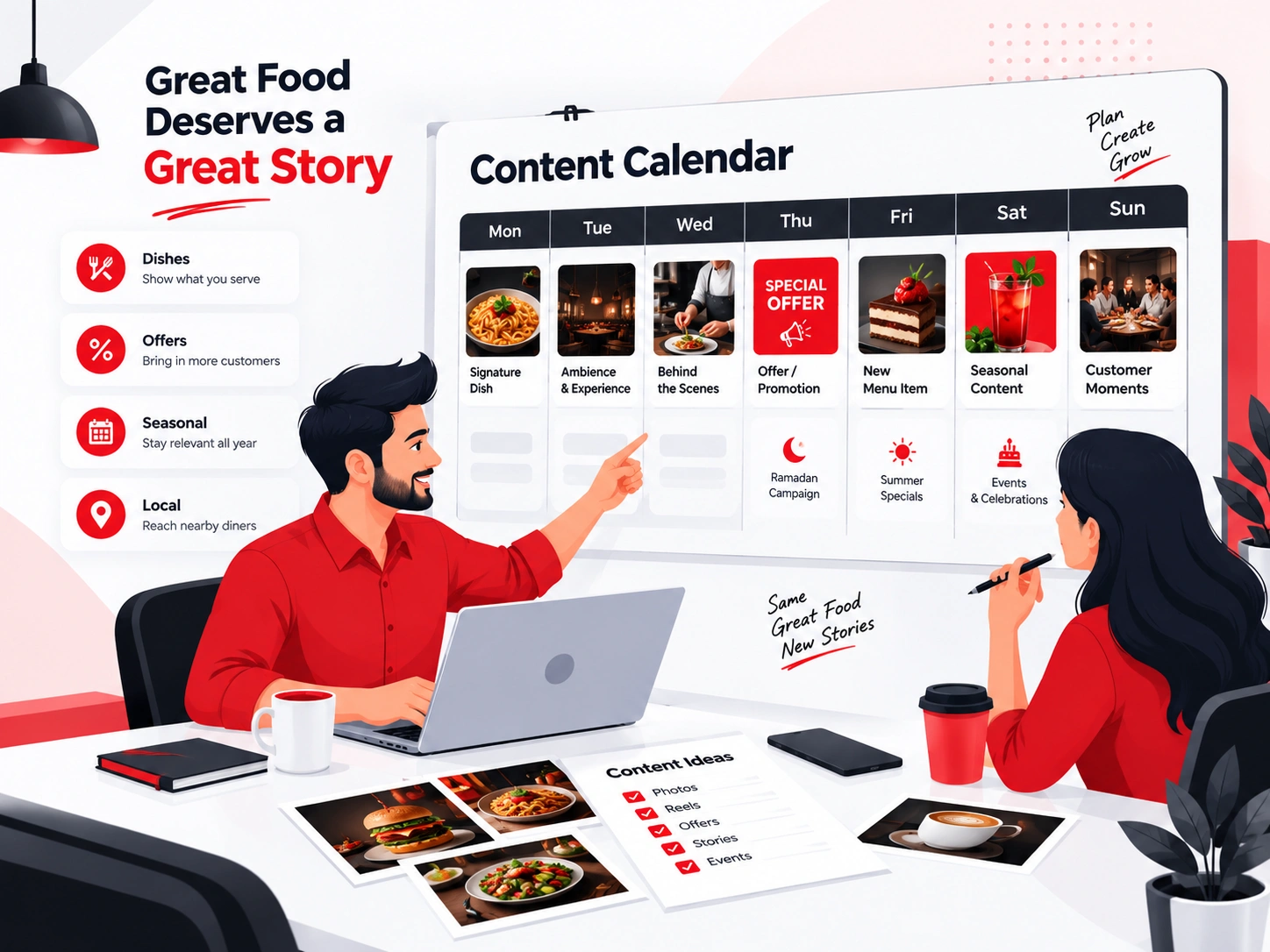
Restaurant social media depends on the restaurant more than most services do, and the projects that run well are the ones where these are settled in week one.
Fifteen minutes during a quiet hour produces more usable footage than an hour during service. It needs to be scheduled rather than requested on the day.
A new dish that appears on Tuesday and gets mentioned to us on Friday has already lost its launch. Early notice is the difference between a campaign and a post.
These go in the bio, the highlights and the offer wording. When they change and we are not told, the account starts misinforming your customers on your behalf.
Content approval that waits on three people loses the moment. A single approver who can say yes to a calendar keeps the month on schedule.
We monitor and pass enquiries across, but availability and booking questions need your side. Agree who has the phone on a Saturday evening before it matters.
Which days, which branches, whether it applies to delivery, what it excludes. Unclear offer terms create arguments at the till that a customer then writes a review about.
Not the same business
They get grouped together because they both serve food, but they sell different things and the accounts should not look alike.
| Restaurants | Cafés | |
|---|---|---|
| What is being sold | An occasion. Dinner, a family meal, a celebration, a group booking. | A habit and a place to sit. Coffee, dessert, two hours at a table. |
| Spend and frequency | Higher spend, lower frequency. A good month is more covers. | Lower spend, much higher frequency. A good month is more regulars. |
| Who decides | Usually a group, so content has to satisfy more than one person. | Usually one person deciding where to spend an afternoon. |
| Content that carries it | Signature dishes, preparation, the room at full service, occasions. | Light, seating, plugs and wifi, the distinctive drink or dessert. |
| Campaigns that fit | Dinner and weekend traffic, dish launches, reservations, group dining. | Breakfast and brunch, quiet-daypart offers, new seasonal items. |
| The audience worth targeting | Families and groups within a realistic evening travelling distance. | Students, remote workers and a tight radius people walk or drive briefly. |
The practical consequence is that a café's most valuable content is often the space rather than the menu. People pick a café for where they will sit, and an account full of beautifully shot drinks with no sense of the room is answering the wrong question.
Karachi
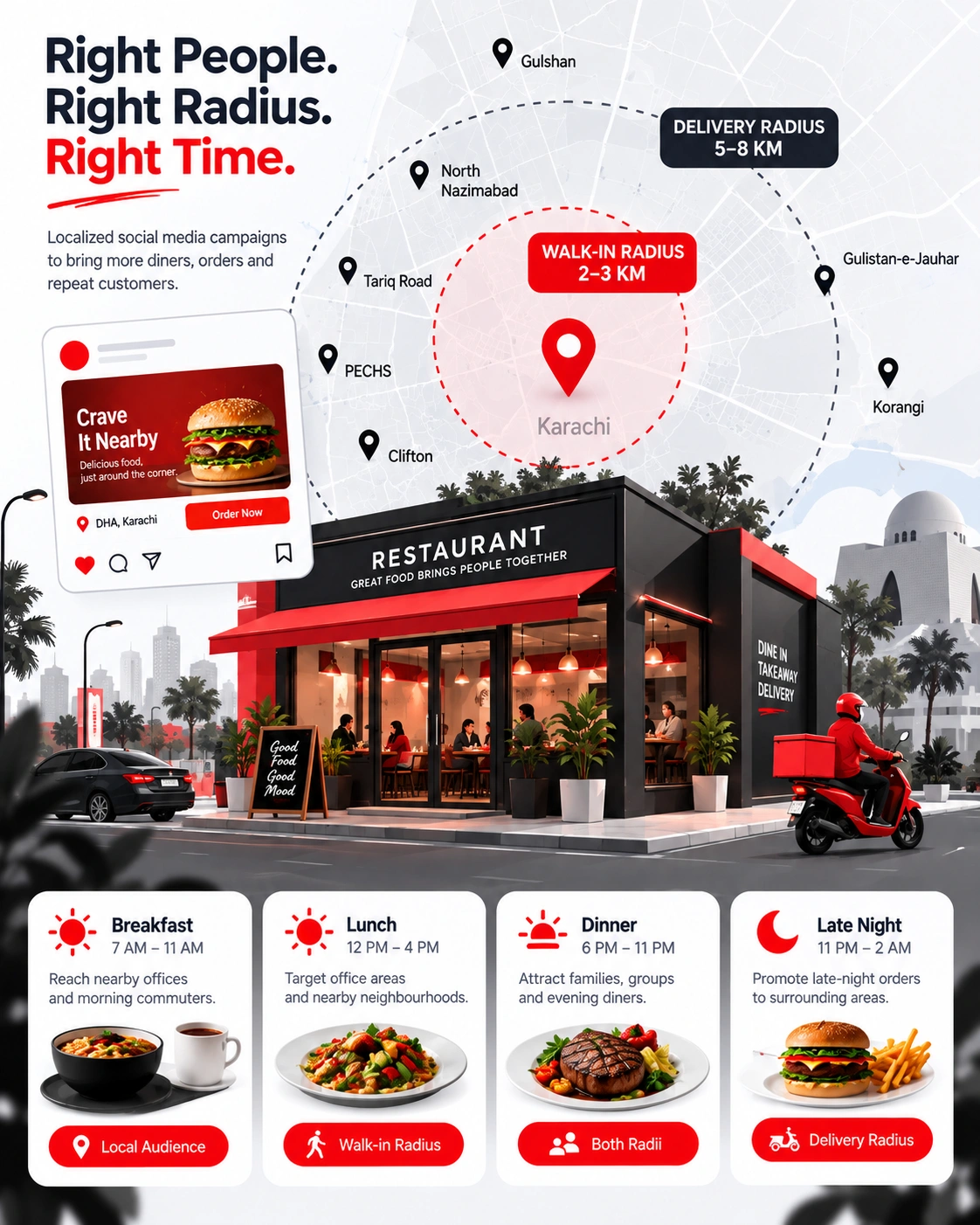
A restaurant has a realistic catchment and it is smaller than most campaigns assume. Someone in North Nazimabad is not a plausible walk-in for a café in Clifton on a weekday, and paying to reach them is the most common waste in restaurant advertising here.
Two settings do most of the work. The first is radius, which differs for dine-in and delivery and should differ again for a weekday lunch and a Saturday dinner. The second is timing. A lunch campaign and a dinner campaign are not one campaign running all day. They have different audiences, different creative, different budgets and different hours, and running them as one is paying to advertise dinner to people at their desks.
Areas like DHA, Clifton, PECHS, Gulshan-e-Iqbal, Bahadurabad, Tariq Road and Gulistan-e-Jauhar behave differently in competition and in how far people will travel. We plan the catchment around your location and your objective rather than building a page for each neighbourhood, which serves nobody.
Multi-branch groups need this handled per outlet. One account can run centrally while campaigns and offers run branch by branch, otherwise your own locations compete for the same people.
Measurement
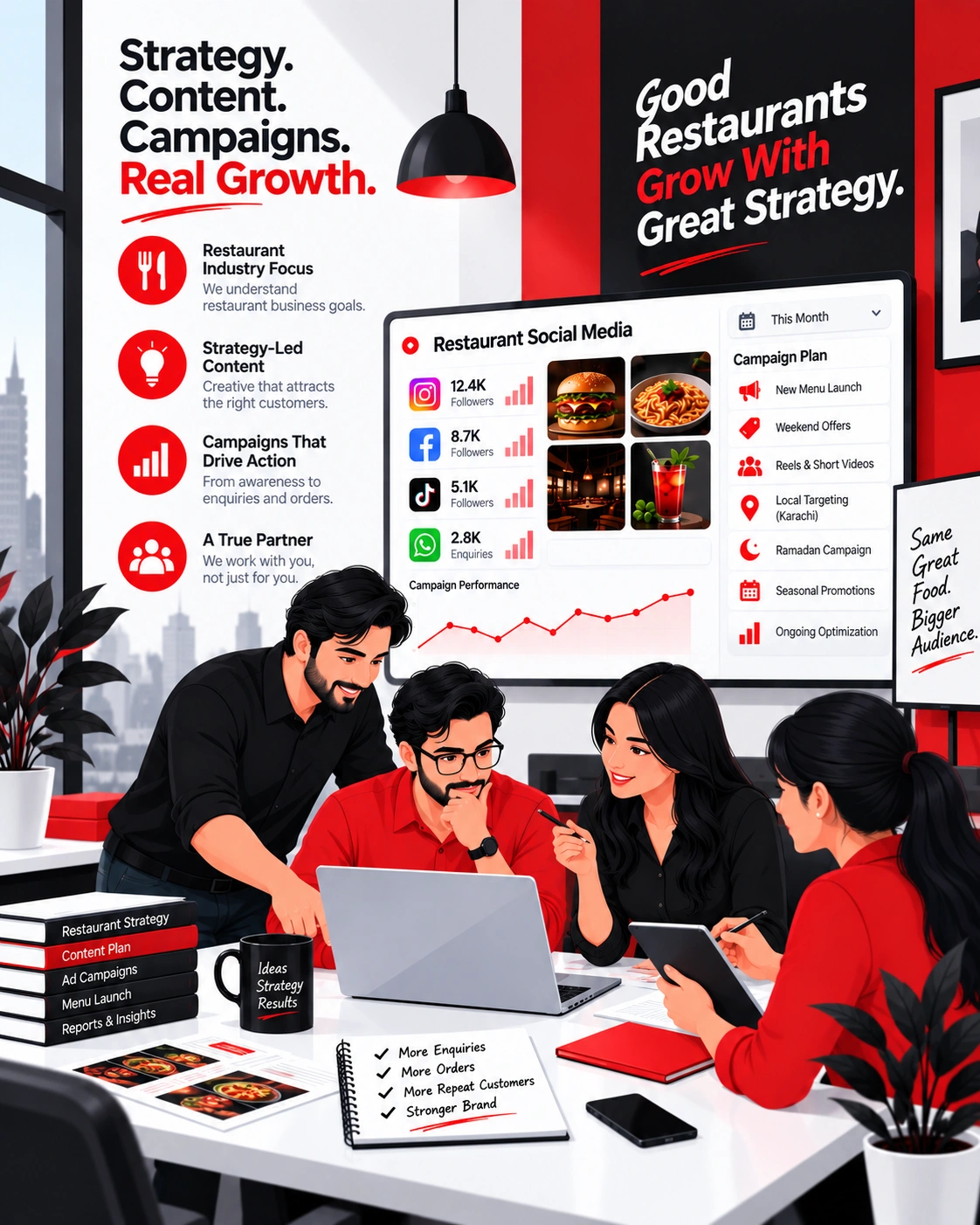
Followers are the easiest number to grow and the least connected to a full dining room. The report should answer whether the account produced anything, and it should be equally clear about what cannot be proven.
The practical response to untrackable footfall is not to pretend it is trackable. It is to ask at the table. A single question from your staff about how someone heard of you, recorded for two weeks, tells you more than any attribution model available at this budget.
Packages
Four monthly plans covering strategy, content, management and campaigns. Every plan includes a monthly report. For most single-location restaurants and cafés, Growth is the realistic starting point, because reel volume matters more in food than in almost any other category.
PKR 30,000per month
For small businesses moving from ad-hoc posting to a managed, consistent presence.
PKR 40,000per month
For businesses with an established presence that need more content and active engagement.
PKR 50,000per month
For established businesses running paid campaigns alongside organic content.
PKR 60,000per month
For brands running continuous campaigns across several platforms with ongoing optimisation.
Advertising spend is separate. The fees above cover strategy, content production, management and campaign work by DIGICS. Any budget spent on Meta or TikTok advertising is paid directly to the platform and is not included. Original video production is quoted separately where a project needs a dedicated shoot. Content volume and campaign scope may be adjusted to suit your restaurant, platform mix and agreed strategy.
Multiple branches usually need more than the content volume alone suggests, because campaigns and offers run per location. Tell us how many outlets you have and we will say which plan actually fits rather than the one that looks closest. These are our general social media plans applied to food businesses. The broader service is described on our social media marketing page.
Why DIGICS
We are a digital agency in Gulshan-e-Iqbal working across design, video, web and marketing. For a restaurant, that matters in a specific way: when the reel works and the menu page takes six seconds to load on mobile data, we can fix the page rather than report it as somebody else's problem.
Design and animation sit in the same company, so a campaign needing a new graphic or an animated menu board does not require a second supplier and a second quotation. And where the practical answer is search rather than social, we will say so and point you at restaurant SEO instead of selling you both by default.
What we will not do is promise a number of covers. Nobody can. What we can commit to is content produced on schedule, campaigns with a stated objective, enquiries passed to you while the person is still interested, and a monthly report written in language you can act on.
If your menu page is the weak link, that is web development work, and we would rather fix it than keep sending traffic to it.
Questions
For most food businesses it is one of the few channels where the product photographs well enough to sell itself, which is a real advantage. Whether it produces a return depends less on the content than on what happens after it. A restaurant with good food, clear pricing, a readable menu and somebody answering messages will do well. A restaurant where the craving is created and then the customer cannot find the price or gets no reply will spend money and wonder where it went.
Usually Instagram and Facebook, with TikTok where the kitchen produces genuinely watchable footage. Instagram carries visual discovery and reels. Facebook still holds the broadest local reach and the more mature advertising tools for location targeting. TikTok can reach far beyond your followers but needs native video rather than reposted graphics. Two platforms done properly beats four done thinly, and we would rather recommend fewer.
A mix of six things rather than a rotation of plated dishes: the two or three items you are known for, food being prepared, the room and how it feels when full, offers with their conditions stated, content your own customers made, and seasonal moments. The most commonly missed one is the room. People choose cafés for where they will sit, and an account that never shows the space is answering half the question.
Yes, and every package includes them, because short-form video carries most of the organic reach in food. Depending on the project we work from footage you supply, from stock and motion graphics, or from material shot specifically for the campaign. Where a project needs original video production with a dedicated shoot, that is agreed and quoted separately rather than assumed inside the monthly fee.
Not to begin. A modern phone in reasonable light produces material that performs well, and preparation footage often outperforms polished plating because it feels real. Professional photography is worth it for a menu launch, a rebrand or the images that will sit on your profile and website for a year. It is a poor use of budget for content that will be seen once and scrolled past.
Yes, and it usually should be tighter than owners expect. We set a radius around your location rather than targeting Karachi as a whole, with different radii for dine-in and delivery, and separate campaigns for lunch and dinner rather than one running all day. Paying to reach someone forty minutes away who was never going to travel is the most common waste in restaurant advertising.
That is the right question to ask, and the honest answer is that we can build for enquiries and report on them, but we cannot guarantee a number. What we report is messages received, calls, direction requests, menu clicks and campaign results against spend. What no agency can prove is that a specific walk-in came from a specific reel, because somebody who saw your content three weeks ago and arrived on Friday is untraceable.
We measure the actions that are trackable: enquiries, calls, direction requests, menu clicks, campaign cost per enquiry and branch-level breakdown. For the part that is not trackable, the practical answer is to ask at the table. One question from your staff about how a customer heard of you, recorded for two weeks, gives you more than any attribution tool available at this budget.
Yes, and it needs structuring rather than simply posting more. One account can run centrally for brand consistency while campaigns, offers and targeting run per branch, so your outlets reach their own catchments instead of competing for the same people. Reporting should also separate by location, because an offer that works in one area often does nothing in another.
Paid campaign setup and management is included on the Professional and Premium plans. Campaigns are built with a stated objective, audience and creative set rather than boosting whichever post performed organically. Advertising budget is separate and paid directly to the platform, and campaign spend is reported alongside results so you can see exactly what went out and what came back.
Our plans run from PKR 30,000 to PKR 60,000 per month, covering platforms, content volume, management and campaign work. The things that move the price are how many platforms you need, how much video is involved, whether paid campaign management is included and how many branches you run. Advertising budget is always separate from the management fee, and a dedicated video shoot is quoted separately.
Social reaches people who are not yet looking for anywhere to eat and makes them want to. Search reaches people at the moment they are actively deciding, including people who have never heard of you. Social creates the demand, search captures it. Most restaurants that fill tables consistently do both, and if only one is affordable right now we will tell you which fits your situation rather than selling you both.
We will look at your profiles the way a hungry customer would: whether the content makes anyone want the food, whether the price, timings and location are findable, and how long a message sits before it gets answered. Free, no obligation, and you get the audit whether or not you work with us.
DIGICS Pvt Ltd · WhatsApp +92 332 229 2181