
Online stores built around your products, your customers and how your business actually operates. DIGICS develops e-commerce websites for businesses in Karachi and across Pakistan, covering catalogue structure, checkout, payment and shipping workflows, and the technical foundations your store will need as it grows.
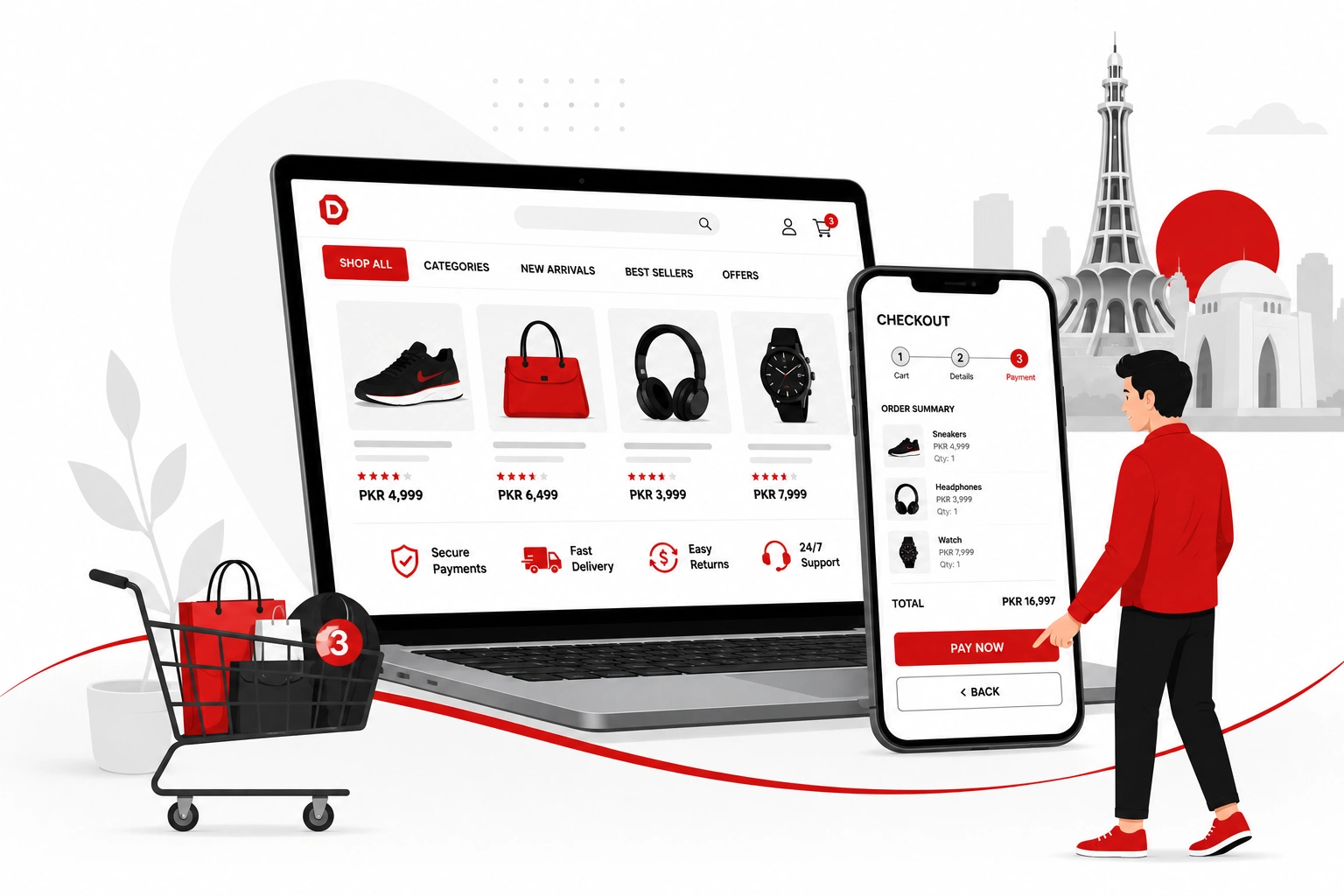
E-commerce web development is the process of building a website that sells products or services online, including the product catalogue, shopping cart, checkout, payment handling, shipping workflows and order management that a business needs to trade.
It differs from building a standard business website in an important way. A brochure site presents information. An online store handles transactions, inventory and customer data, which means the decisions made during development affect how easily you can run the business afterwards, not just how the site looks.
DIGICS builds e-commerce websites for businesses in Karachi and across Pakistan. Our work covers store planning and catalogue architecture, responsive front-end development, cart and checkout, payment and courier integration, order and inventory workflows, analytics, and a technical foundation that supports search visibility later.
This is the point most businesses discover after launch rather than before it. A brochure website is finished when it goes live. An e-commerce website is a system your team operates every day.
The consequences of that difference are practical. Someone has to add products, fulfil orders, handle returns and reconcile payments. If the catalogue was structured badly at the planning stage, every one of those tasks costs more time, permanently.
It also changes what "done" means. A store needs testing across payment failure states, stock edge cases and mobile checkout before it launches, because a broken checkout is not a cosmetic issue. It is lost revenue that nobody reports to you.
We plan for that from the start, which is why our first conversation is about your products, your order volume and who will run the store, rather than about design.
Tell us what you sell and roughly how many products you carry. We will come back with an honest view of what the project involves, which package fits, and what it would take to build.
Eight areas of work. Which of them your project needs depends on what you sell, how you fulfil orders and what systems you already run.
How the store is organised before anything is built: page types, user journeys, admin roles and how the site will scale as products are added.
Categories, variants, attributes, SKUs and filters. Getting this right at the start is what keeps the store manageable at five hundred products.
Most store traffic in Pakistan arrives on a phone. The mobile experience is designed first and the desktop layout follows, not the other way round.
The highest-value part of the build. Short, clear checkout with guest options, visible shipping costs and no surprises at the final step.
Cash on delivery, card payments, bank transfer and local wallet options, configured against what your business can actually accept and reconcile.
Delivery zones, charges, courier handover, order statuses and the customer notifications that reduce "where is my order" messages.
Analytics and conversion tracking, plus connections to the accounting, inventory, CRM or marketing tools your business already uses.
Clean URLs, crawlable category structure, controllable metadata, product structured data and fast pages, so search visibility can be built later.
Development gives your store a foundation search engines can read. Ranking that store is separate ongoing work, which our SEO team handles as a distinct service.
Every store loses customers between arriving and paying. The development decisions that matter most are the ones that remove friction at each of these five points.
Search and filters that work on real catalogues. If a customer cannot find the product in three taps, they leave.
Product pages with proper images, clear variants, honest stock status and the details that answer a buyer's real question.
Visible delivery times, return policy, contact details and payment options. Uncertainty at this stage is what fills abandoned carts.
Fewest possible fields, guest checkout, mobile keyboards that match the input, and shipping cost shown before the final step.
Immediate confirmation, an order reference, and updates as it ships. This is where repeat customers are made or lost.
We do not claim a specific design change will lift your conversion rate by a set amount. What we can do is remove the known friction points, then track where customers actually drop off so the decisions afterwards are based on your data.
DIGICS operates from Karachi. Selling online in Pakistan has requirements that a store template built for another market does not account for, and getting them wrong creates operational problems rather than cosmetic ones.
Cash on delivery is the clearest example. A large share of Pakistani online orders are still paid on delivery, which means your store needs COD as a first-class option rather than an afterthought, with order confirmation steps that reduce fake and abandoned orders before a courier is dispatched.
Courier handover matters just as much. Order statuses, tracking references and delivery zones need to reflect how your chosen courier actually works, so your team is not re-entering orders into a separate system every morning.
On payment gateways and courier APIs: availability, approval requirements and integration options change. We confirm what is currently supported for your specific business and volume during discovery, rather than promising a list of integrations upfront.
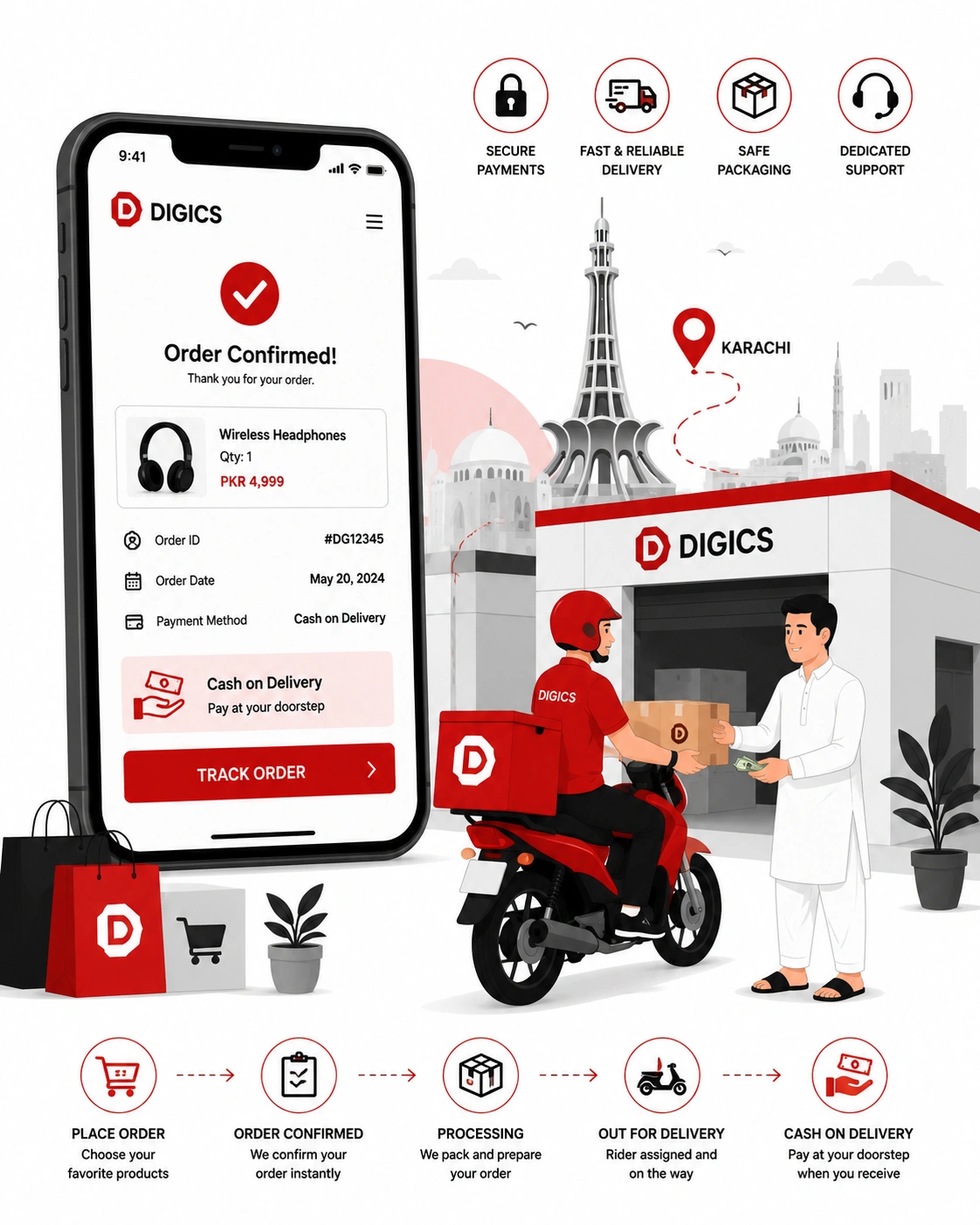
The same store can serve customers in Karachi and customers abroad, provided the groundwork is done during development rather than retrofitted afterwards.
COD as a properly supported payment method, with confirmation steps, order verification and reporting that separates COD from prepaid revenue.
Card payments, bank transfer and local wallet options, configured against what your business is approved to accept. We confirm availability during discovery.
Delivery charges by city or zone, courier handover, tracking references and the order statuses your fulfilment team actually uses.
Built for phones on variable connections: compressed images, light pages and a checkout that works with one thumb.
Where you sell abroad, currency display, international shipping zones, tax configuration and regional product availability can be built in.
Stock levels, low-stock handling, returns and the admin experience for whoever runs the store day to day, which is often overlooked entirely.
Platform choice comes after the requirements, not before. The right answer depends on your catalogue size, how custom your workflows are, who will maintain the store and what budget the project has.
Faster to launch with less to maintain, at the cost of platform fees and limits on deep customisation. Often the right choice for a first store. We also build on Shopify as a dedicated service.
More control over data, workflows and cost at scale, with more responsibility for hosting, updates and security. Suits businesses with specific operational needs. Our WordPress team covers this route.
Where the business model does not fit a standard store, for example unusual pricing rules, B2B ordering or integration with an existing ERP system. Higher investment, fully specified to your requirements.
We will recommend the option that fits the project, including when the cheaper or simpler route is the right one. Hosting is available through our web hosting service or you can host wherever you prefer.
Eight stages. You approve each before the next begins, which keeps the scope predictable and stops problems compounding late in the build.
What you sell, catalogue size, order volume, how fulfilment works, which systems you already use, and who will run the store.
Catalogue structure, page types, required integrations and platform recommendation, documented as a scope you approve before build.
Key screens designed mobile-first: home, category, product, cart and checkout. Reviewed with you before any development starts.
Front-end build, catalogue setup, cart and checkout, admin configuration and the content structure your team will work in.
Payment methods, courier and shipping setup, analytics, and connections to accounting or inventory systems where required.
Real orders placed end to end, including failed payments, out-of-stock states, mobile checkout and every notification the customer receives.
Deployment, redirects if you are replacing an existing store, indexing checks, and handover training for whoever manages the store.
A support window after go-live for issues that only appear under real traffic, plus optional ongoing maintenance.
Projects that stall usually stall for the same reasons. Having answers to these before you brief anyone, including us, will shorten the timeline and sharpen the quote.
Product dataNames, prices, variants, SKUs and descriptions. Missing product data is the most common cause of a delayed launch.
Product photographyConsistent images at a usable resolution. Poor photography limits how good the store can look regardless of the build.
Delivery chargesHow much you charge, by zone or by weight, and whether there is a free delivery threshold.
Payment methodsWhich you can actually accept and reconcile today, not which you would like eventually.
Return policyYour terms in writing. Customers look for this before buying, and it needs to be on the site at launch.
Who runs the storeThe person who will add products and process orders. The admin should be built for them.
Existing systemsAny accounting, inventory or POS software the store must connect to, and whether it offers an API.
Growth expectationCatalogue size in a year, not today. Architecture is far cheaper to plan than to rebuild.
If several of these are still undecided, that is normal and not a reason to delay talking to us. We can work through them with you during discovery.
Four fixed-price packages for businesses launching a standard online store. Each is a one-time development fee, not a subscription.
Starter online store for a small business selling a handful of products.
For businesses with a larger catalogue who want more pages to work with.
A complete store for businesses ready to sell online properly, with everything included to launch.
For businesses that need online payments and a larger catalogue from day one.
Not every online business fits a fixed scope. If you need custom functionality, a larger catalogue, additional integrations, B2B ordering or a migration from an existing store, we will quote against your actual requirements.
The packages above cover most standard stores. Projects that need custom functionality are quoted individually, because a fifty-product WooCommerce store and a custom build integrating with an existing ERP are not comparable.
Custom projects are quoted after discovery, at a fixed price agreed before work begins and broken down by stage so you can see what you are paying for.
If your budget is limited, say so early. There is usually a smaller first version that gets you trading, with the more complex functionality added once the store is earning. That is a better outcome than a scope you cannot finish.
What moves the price:
Tell us what you sell and roughly how many products. We will come back with a scope and a fixed price, usually within two working days.
WhatsApp +92 332 229 2181
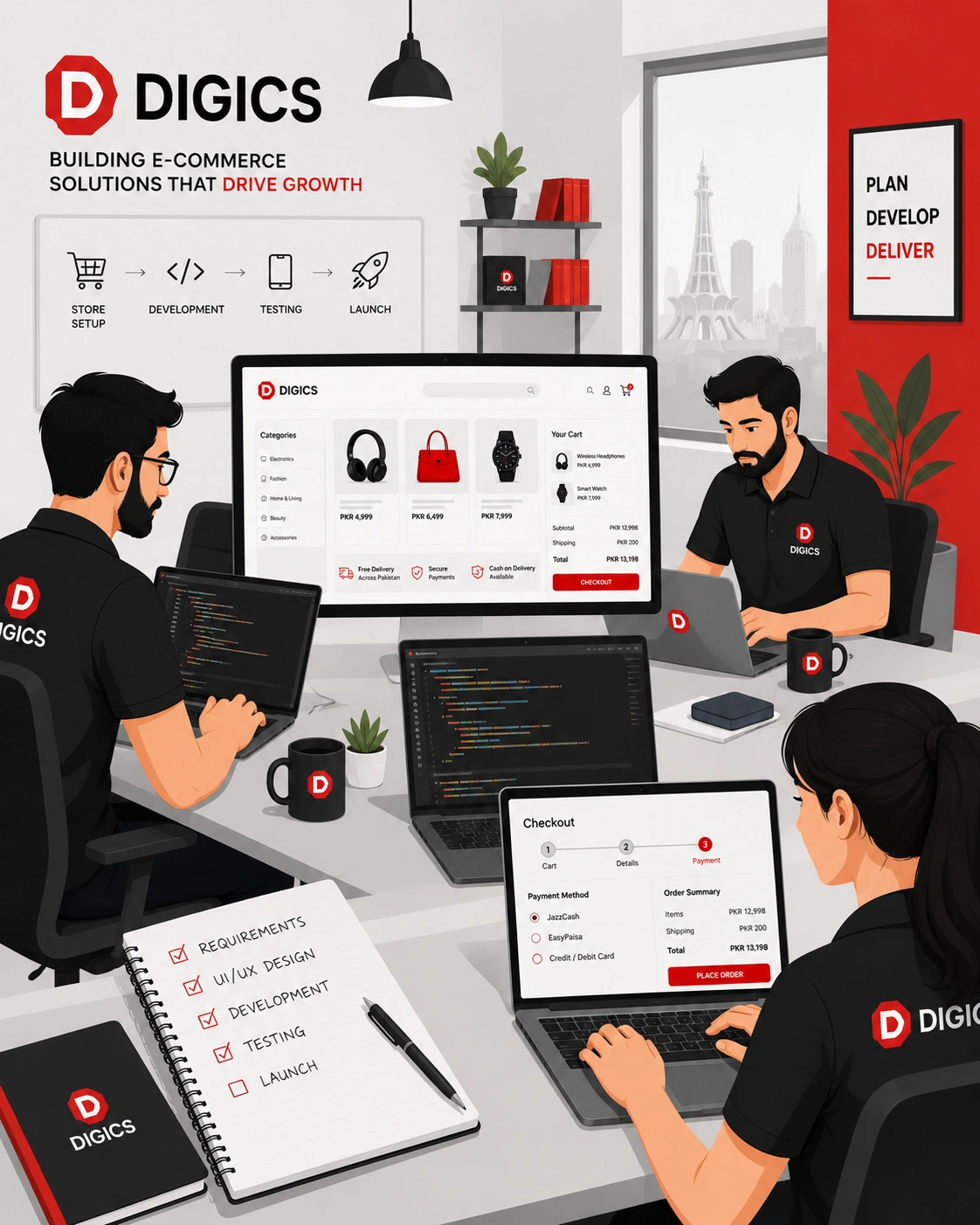
DIGICS runs web development, design, hosting and marketing divisions. Your store is not dependent on one person's availability, and there is someone to call after launch.
Your domain, your hosting account, your platform account, your data. We hand over full admin access at launch, and you are not locked into us to make changes.
Because we also run SEO and social media marketing, stores are built with the structure and tracking those channels will need, rather than requiring rework six months later.
If a hosted platform will serve you better than a custom build, we will say so even though it is the smaller project. Overselling a scope you cannot maintain helps nobody.
It varies too widely for a single figure to be useful. The main factors are catalogue size, how custom the design is, which platform you use, what integrations are required and whether you are migrating from an existing store. A straightforward store on a hosted platform sits at one end of the range; a custom build connecting to an ERP sits at the other. We quote per project after discovery, at a fixed price agreed before work begins. If you tell us what you sell and roughly how many products you carry, we can give you a realistic figure quickly.
A straightforward store with a modest catalogue and standard integrations typically takes several weeks from discovery to launch. Larger catalogues, custom functionality, multiple integrations or a migration from an existing store extend that considerably. The most common cause of delay is not development but waiting on product data and photography, which is why we ask for those early. You get a timeline with your quote, and we would rather tell you a deadline is unrealistic than agree to it and miss it.
There is no single best platform, only the one that fits your requirements. Hosted platforms are faster to launch and need less maintenance but charge ongoing fees and limit deep customisation. Self-hosted options give more control over data and cost at scale but make hosting, updates and security your responsibility. Custom development suits businesses whose model does not fit a standard store. We recommend based on your catalogue, workflows, who will maintain the store and your budget, and that recommendation comes after discovery rather than before it.
Yes, including cash on delivery, card payments, bank transfer and local wallet options. Which specific gateways are available to you depends on your business type, documentation and approval with the provider, and those requirements change over time. Rather than promising a fixed list upfront, we confirm what your business can actually be approved for during discovery and build against that. Cash on delivery is treated as a first-class payment method, not an afterthought, because it remains a significant share of orders in Pakistan.
Yes, subject to what your chosen courier supports. That can range from a full API connection with automatic booking and tracking, through to a simpler workflow where orders are exported and statuses updated manually. Which is available depends on the courier and your account with them. We confirm this during discovery and build the order workflow around what will actually work for your team rather than around what sounds best.
It is built mobile-first, because most store traffic in Pakistan arrives on a phone, often on a variable connection. That means the mobile layout and checkout are designed before the desktop version, images are compressed properly, pages are kept light, and the checkout is tested on real devices rather than only in a browser window resized to look like a phone.
Development gives your store the technical foundation search engines need: clean URLs, a crawlable category structure, controllable page titles and descriptions, product structured data, fast loading and correct handling of filters and pagination. That is what we build in. Actually ranking the store is separate ongoing work involving content, keyword targeting and authority building, which our SEO team handles as a distinct service. A well-built store makes that work easier and cheaper; it does not replace it.
Yes. That usually starts with a review of what exists, what is worth keeping and what is causing the problems you are experiencing. Migrating products, customers and order history is its own workstream and needs planning, particularly around preserving URLs so existing search visibility is not lost. Sometimes the honest answer is that fixing the current store is better value than replacing it, and we will tell you if that is the case.
Yes, where your business is set up to fulfil internationally. That involves currency display, international shipping zones and charges, tax configuration and controlling which products are available in which regions. It is considerably easier to build in from the start than to add later, so if international selling is part of the plan even at a distance, mention it during discovery.
You do. Domain, hosting, platform account and data are registered to your business, and you receive full administrative access at launch. We do not hold your accounts hostage to keep you as a client, and you are free to take the store elsewhere or maintain it yourself.
Yes. Every project includes a support window after go-live for issues that only surface under real traffic and real orders, which is when most problems appear. Beyond that, ongoing maintenance covering updates, security, backups and small changes is available separately if you want it, or you can manage the store yourself.
Usually, provided the system offers an API or a supported export format. Common cases include syncing stock levels, pushing orders into accounting software and keeping product data consistent between a POS and the online store. We check what your specific software supports during discovery, because the answer differs considerably between systems and versions.
Tell us what you sell and how you deliver it. We will come back with a scope, a realistic timeline and a fixed price. No obligation, and no pressure to proceed.
Get an E-commerce Project QuoteDIGICS Pvt Ltd · WhatsApp +92 332 229 2181